Welcome back to the workbench! Look, we all love the smell of melting rosin core solder in the morning. It smells like… victory. Or, more accurately, it smells like asthma, burning eyes, and a massive headache. You might think you can just hold your breath like you’re diving for pearls while trying to solder that tiny 0805 SMD resistor, but sooner or later, that wispy white smoke is going directly up your nostrils. And no, blowing on it gently while leaning your head back at a 45-degree angle does not count as a valid occupational safety protocol.
If you’ve progressed past the “blinking an LED” stage and are now spending your Friday nights doing Advanced Soldering or fixing spaghetti code in a cloud of flux vapor, it’s time to get a fume extractor.
Today we’re pitting the industry-standard Hakko FA-400 against the budget-favorite Kotto Solder Fume Extractor Absorber. Let’s see which one is best at sucking up your mistakes before you breathe them in.
The Industry Standard: Hakko FA-400 Fume Extractor
Walk into any professional electronics lab, repair shop, or high-end maker space, and you will see this blue and yellow box sitting on the bench. Hakko is legendary for their soldering stations, and their fume extractors are built to the exact same bulletproof standards.
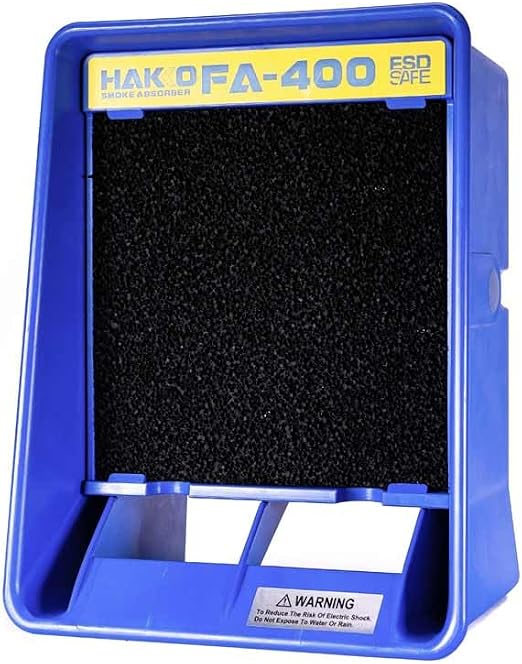
The Hakko FA-400 isn’t just a basic PC fan glued to a piece of foam. It’s a precisely engineered airflow system designed to maximize the capture of noxious flux fumes.
Why it matters for Beginners: The coolest feature of the FA-400 is that it can operate in two positions: standing up or lying flat. When it’s lying flat (low-profile mode), it creates a high-efficiency airflow directly across the surface of the PCB. This is incredible because it sucks the smoke away before it even has a chance to rise up to your face, making your soldering experience vastly more comfortable.
Why it matters for Pros: Reliability and filter quality. Pros know that cheap fans burn out when run for 12 hours a day. The Hakko uses a highly reliable AC motor that will outlast the desk it sits on. Furthermore, the activated carbon filters used by Hakko are thick, dense, and actually trap the chemical particulates rather than just redistributing them around the room. Plus, it’s ESD-safe by design, meaning you won’t accidentally zap a sensitive ESP32 microcontroller with static discharge from a cheap plastic housing.
- Best For: Professional techs, serious hobbyists, and anyone who solders daily.
- Get it here: Hakko FA-400 on Amazon
The Budget Challenger: Kotto Solder Fume Extractor
Let’s be honest. Not everyone wants to drop premium money on a fan and some foam. If you’re building a weekend Line Following Robot and just want to stop coughing, the Kotto Solder Fume Extractor is calling your name.
Kotto Solder Fume Extractor Absorber
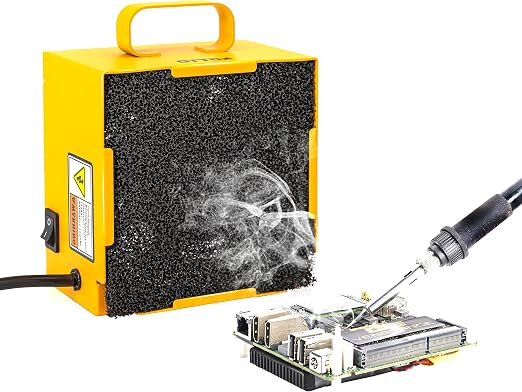
The Kotto has gained a massive following in the maker community by offering incredible bang for the buck. It’s essentially a very high-RPM 120mm fan bolted to a sturdy metal stand, bundled with a massive stack of replacement carbon filters.
Why it matters for Beginners: Value. You get the extractor, a long power cord with an inline switch, and enough replacement activated carbon filters to last you for years of weekend projects—all for less than half the price of the premium models. It has surprisingly strong suction; as long as you place it within 6 to 8 inches of your soldering iron, it will grab the smoke before it reaches your lungs.
Why it matters for Pros: While it doesn’t have the fancy dual-position airflow dynamics of the Hakko, the Kotto is built like a tank. The housing is made of solid metal, not plastic, which makes it heavy and stable on the bench. The metal construction also makes it inherently robust against accidental knocks or rogue hot soldering iron tips that would instantly melt a plastic fan shroud.
- Best For: Beginners, students, and budget-conscious makers who want great suction without the premium price tag.
- Get it here: Kotto Solder Fume Extractor on Amazon
The Verdict
Which one should you put on your bench?
If you are a student or a weekend warrior working on smaller breadboard projects, the Kotto Solder Fume Extractor is a no-brainer. The metal chassis is durable, the suction is solid, and the inclusion of extra filters makes it a fantastic budget choice.
However, if you spend hours at the bench, frequently tackle large surface-mount (SMD) custom PCB designs, or just want the absolute best airflow control available, spend the extra cash on the Hakko FA-400. The low-profile flat-flow mode is a game changer for keeping smoke out of your eyes while working under a microscope, and its ESD-safe design ensures your expensive ICs survive the operation.
Keep breathing easy, protect those lungs, and may your solder joints always be shiny!