Project 1: Basic LED Throwies
Welcome to the very first project in the Workshop! If you have never built a circuit before, this is the absolute best place to start because it is almost impossible to screw up. A “Throwie” is the simplest circuit in existence. It consists of three parts: a battery, a light, and a piece of tape. It requires no code, no soldering, and no dignity. Let’s make some glowing garbage.
(Image: A glowing LED taped to a coin cell battery)
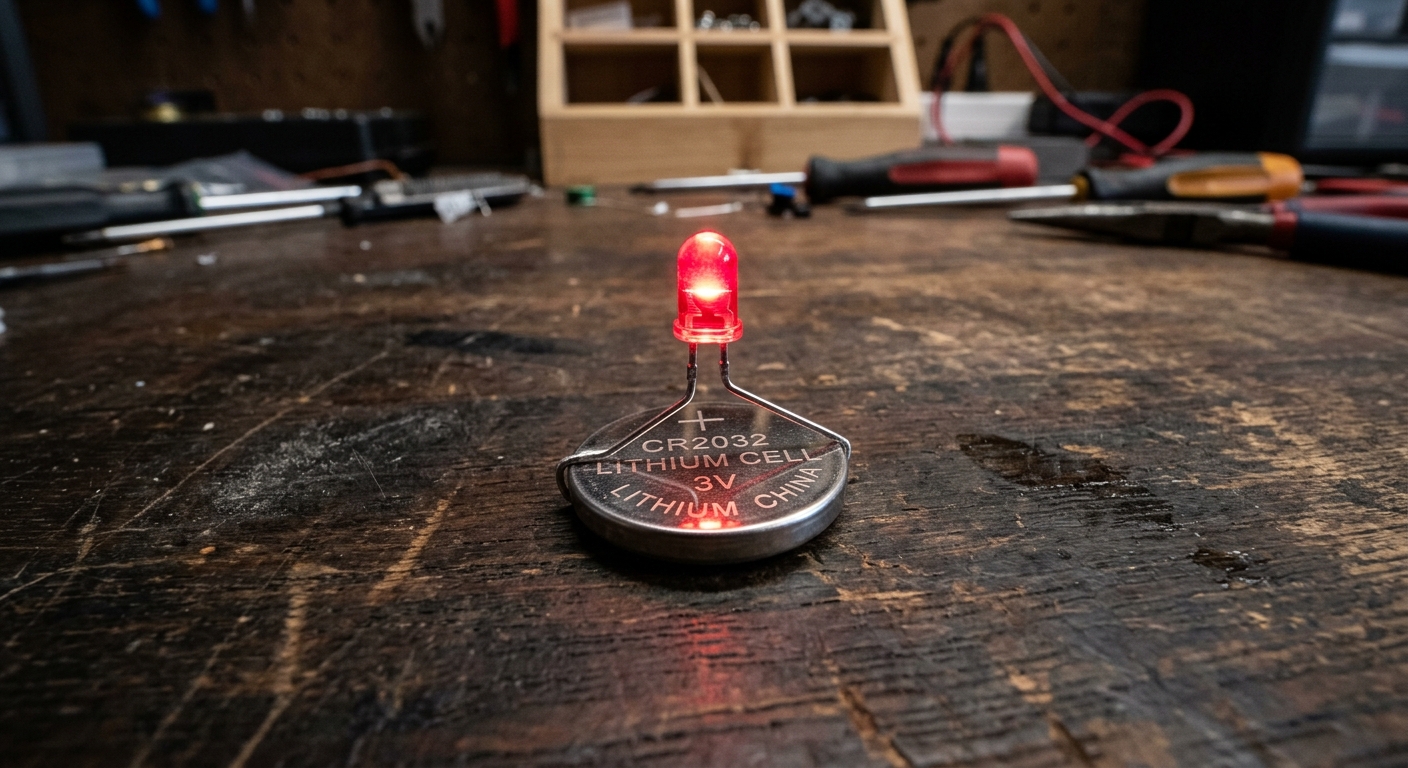
The Goal
To understand the absolute basics of a complete circuit: power source, load, and polarity.
The Parts List
- 1x 5mm or 10mm LED (Any color, but Red or Green are easiest to power)
- 1x CR2032 3V Coin Cell Battery (The kind used in watches and car key fobs)
- A piece of electrical tape or a strong small magnet if you want to stick it to metal.
How to Build It
- Identify the Anode and Cathode: Pick up your LED. You will notice two things: one wire leg is longer than the other, and the plastic bulb has a flat edge on one side.
- The long leg is the Anode (Positive +).
- The short leg is the Cathode (Negative -).
- Identify the Battery Terminals: Look at your CR2032 coin cell battery. One side has a large ”+” engraved on it. This is the positive side. The other blank side is the negative side.
- Make the Connection: Slide the coin cell battery between the two legs of the LED.
- The long leg of the LED must touch the ”+” side of the battery.
- The short leg of the LED must touch the blank (negative) side of the battery.
- Let there be light: The moment both legs firmly touch the correct sides of the battery, the LED will light up!
- Secure it: Wrap a piece of electrical tape tightly around the battery and the legs to hold them in place.
What We Learned
You just built a complete electrical circuit! The electricity flows from the positive side of the battery, through the LED (where it does the “work” of creating light), and back into the negative side of the battery.
Wait, why didn’t we use a resistor? If you read Lesson 104, you know that LEDs usually explode if you don’t use a resistor to limit the current. So why did this work? It works because coin cell batteries have a high Internal Resistance. They are physically incapable of dumping out enough current fast enough to blow up the LED. The battery itself acts as its own current-limiting resistor! This trick only works with small coin cells—do not try this with a 9V battery or AA batteries, or the LED will pop!
Enjoy your first working circuit. Leave it on your desk, or toss it in the dark to see it glow!