Welcome to Lesson 104! Let’s give a standing ovation for the LED—aka Light Emitting Diode—aka the fabulous little drama queen of the electronics world.
How LEDs Work
An LED is a specific type of diode that lights up when you treat it just right. Too little voltage? Nothing. Too much? They explode faster than your patience during IKEA assembly.
To keep these tiny divas happy, you must follow two strict rules:
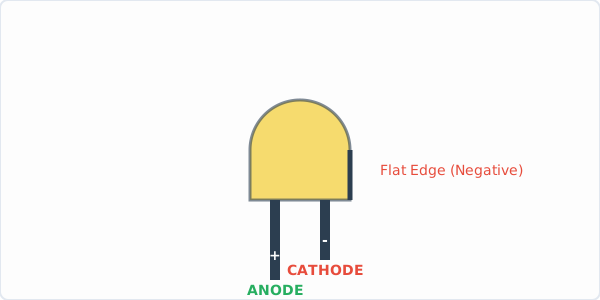
1. They are Directional (Polarized) Because an LED is a diode, electricity can only flow through it in one direction. Plug them in backward and they’ll sit there like, “I’m not mad… I’m just disappointed.”
- The longer leg is the Anode (Positive).
- The shorter leg (or the flat side of the bulb) is the Cathode (Negative). Yes, LED legs are literally how you tell their mood.
2. They Require a Chaperone (Resistor) LEDs are greedy. If you connect an LED directly to a battery without a resistor, you’re sending them to a rave with no rules. They will draw as much current as possible and burn out in a fraction of a second. Rule of thumb: Always use a resistor in series with your LED to limit the current to a safe level (usually around 20 milliamps).
Types of LEDs
LEDs have evolved far beyond standard red indicator lights. Today, you can use:
- RGB LEDs: Contain red, green, and blue elements in one package, allowing you to mix them to create almost any color using code (mood rings for your circuit).
- Addressable LEDs (NeoPixels): Strips of LEDs where each individual light can be controlled independently by a microcontroller.
Treat your LEDs like royalty, and they’ll glow up your project. Mistreat them, and they’ll die silently in the night.
Recommended Gear:
- Assorted Color LED Pack (5mm) - Perfect for breadboard prototyping.
- Arduino Starter Kit - The best way to learn how to control LEDs with code.