Beginner Oscilloscopes Showdown: Rigol vs. Siglent vs. Hantek
As you dive deeper into electronics, a multimeter simply won’t cut it. A multimeter gives you the average voltage; an oscilloscope lets you literally see electricity moving in real-time, allowing you to watch your signals fail spectacularly. Thankfully, you don’t need $2,000 to get one anymore. Let’s compare three popular sub-$400 models for beginners and explain why you probably want one.
1. The High-Res Powerhouse: Rigol DHO804
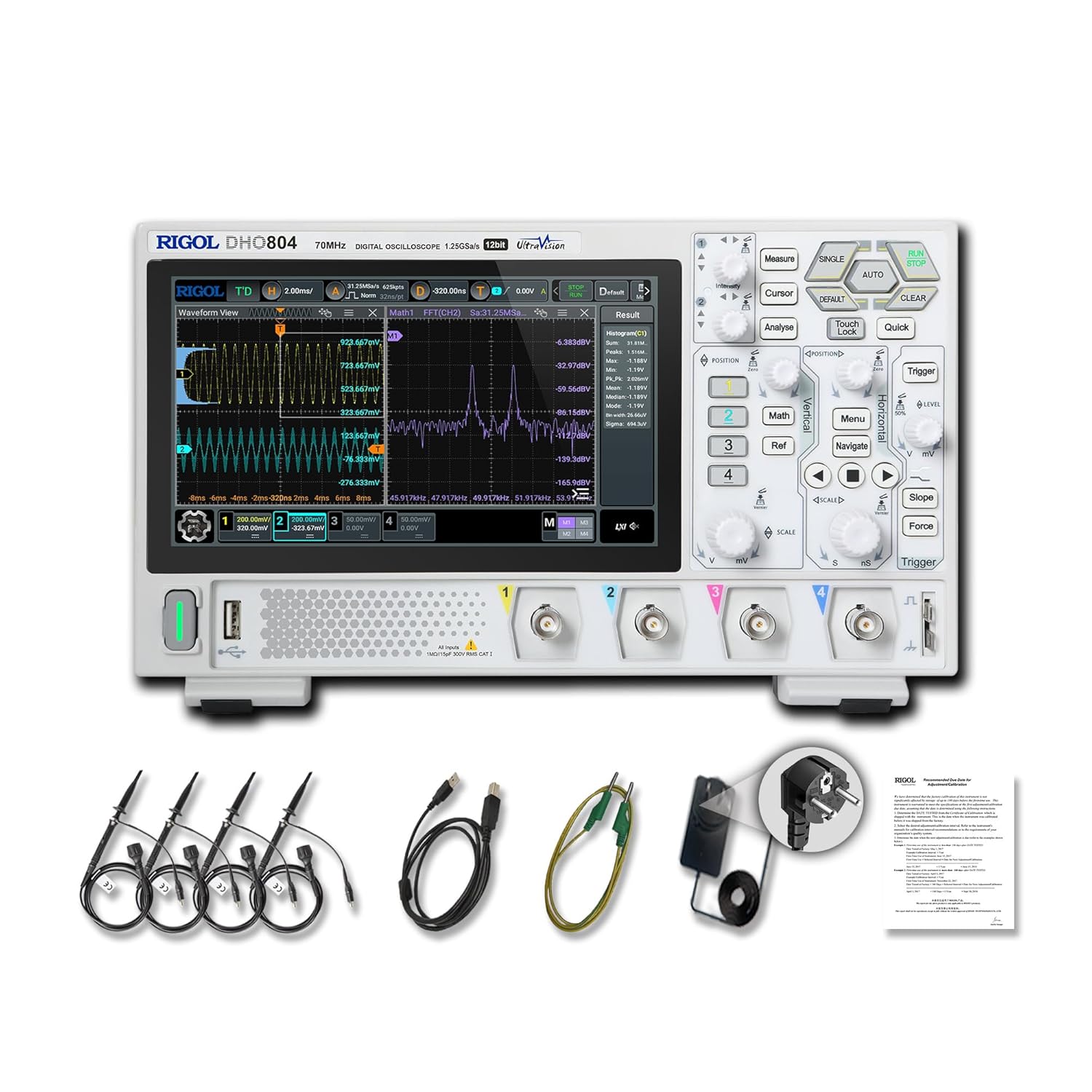
- Estimated Price: ~$399
- Direct Link: Rigol DHO804 on Amazon
- Type: 4-Channel, 70 MHz Benchtop
Why it matters: The Rigol DHO800 series is the new darling of the maker community. It features a stunning 7-inch touchscreen and runs on Android. More importantly, it has a 12-bit ADC (Analog-to-Digital Converter). Most budget scopes are 8-bit.
Beginner vs. Pro: To a beginner, “12-bit” sounds like marketing jargon. To a pro, it means the scope can display incredibly tiny variations in voltage that an 8-bit scope would completely smooth over. If you are debugging a delicate sensor or analyzing noise in an audio circuit, that extra resolution is a lifesaver. Furthermore, having four channels means you can watch four different signals at once—essential for troubleshooting SPI (which uses 4 wires) or complex logic.
2. The Proven Workhorse: Siglent SDS1202X-E
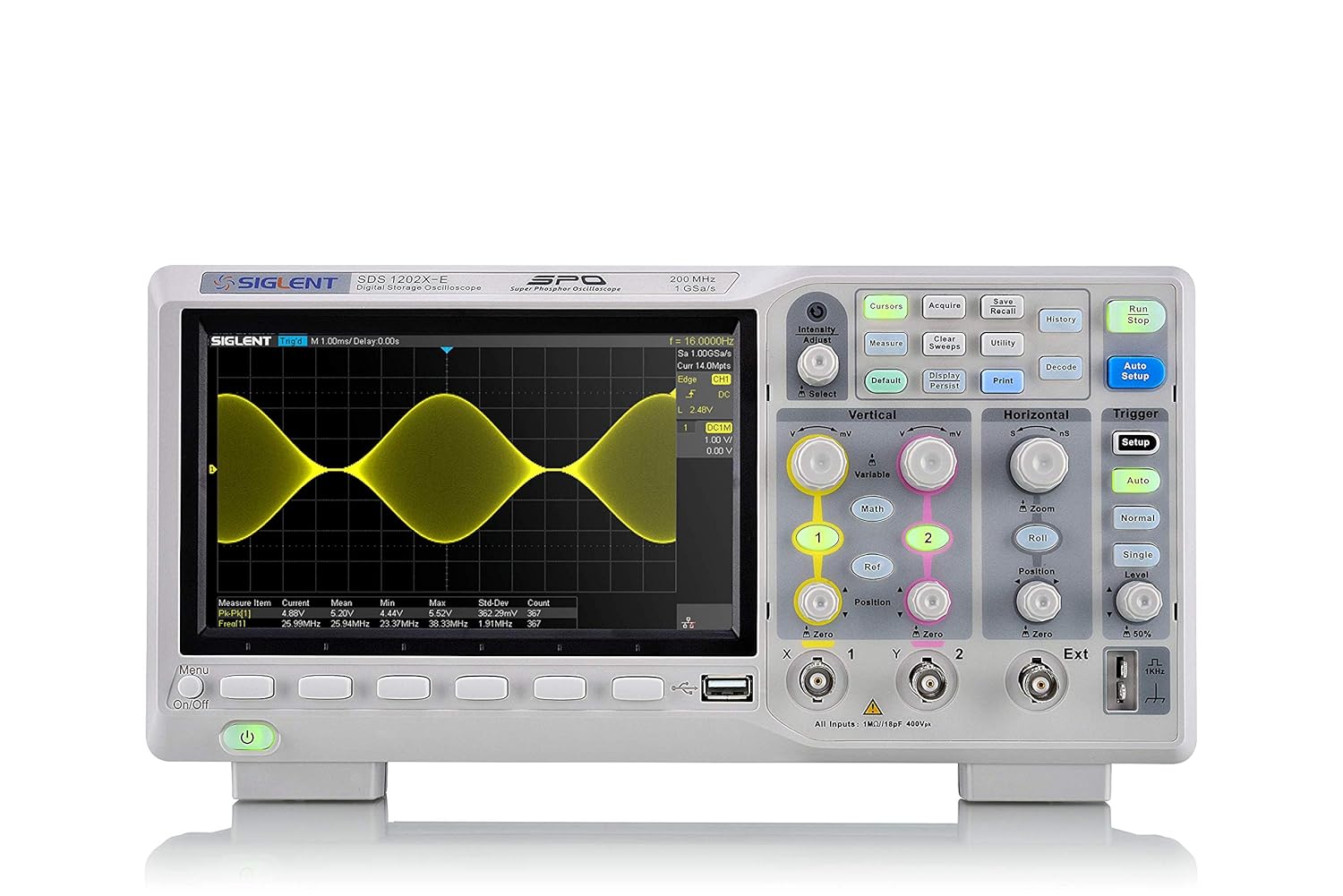
- Estimated Price: ~$379
- Direct Link: Siglent SDS1202X-E on Amazon
- Type: 2-Channel, 200 MHz Benchtop
Why it matters: Siglent has been the gold standard for budget scopes for years. This model is only 2 channels and 8-bit, but it makes up for it with massive bandwidth (200 MHz) and excellent, snappy firmware.
Beginner vs. Pro: Bandwidth determines the fastest signal the scope can accurately measure. A 70 MHz scope might struggle to cleanly display a fast 50 MHz clock signal. A 200 MHz scope handles it with ease. A beginner making LEDs blink on an Arduino (16 MHz) won’t need 200 MHz. But a pro working with high-speed microcontrollers (like the ESP32 or Raspberry Pi Pico) or RF signals needs the extra speed. If sheer speed is more important to you than having 4 channels, the Siglent is the winner.
3. The Portable Multi-Tool: Hantek 2D42
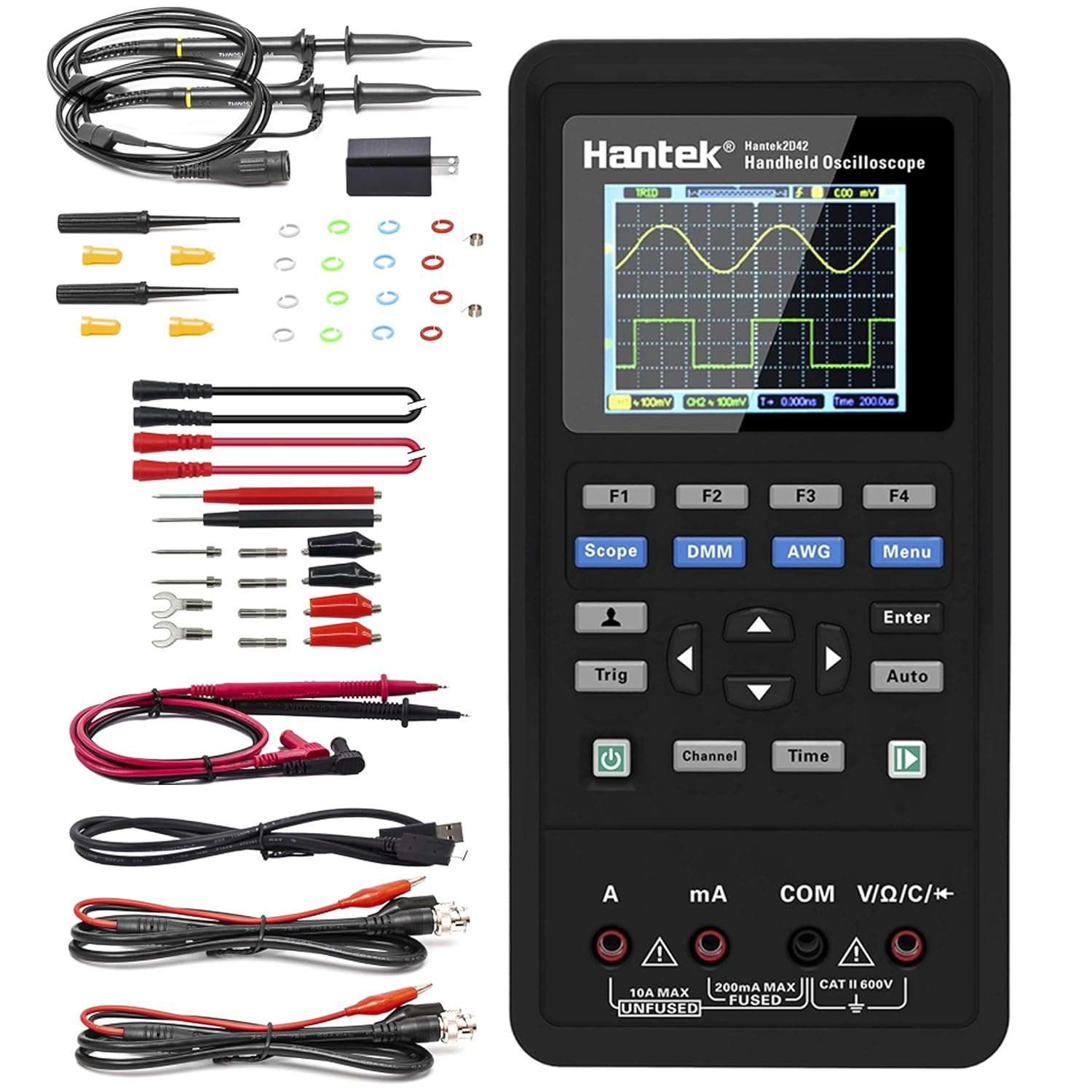
- Estimated Price: ~$130
- Direct Link: Hantek 2D42 on Amazon
- Type: 2-Channel, 40 MHz Handheld (with Multimeter & AWG)
Why it matters: The Hantek 2D42 is a completely different beast. It looks like a bulky multimeter because it is a multimeter, but it also packs a 40MHz oscilloscope and an Arbitrary Waveform Generator (AWG) into a battery-powered handheld unit.
Beginner vs. Pro: For a beginner who doesn’t have a dedicated electronics desk, a benchtop scope can be a bulky annoyance. The Hantek can be thrown in a toolbox, taken out to your car to diagnose a bad sensor, or used on a cramped desk. Pros generally dislike handheld scopes because the interface is clunky (you have to navigate menus using buttons instead of dedicated knobs) and the screen is small. However, if you need true portability, or you’re on a very tight budget, this is a fantastic entry point that gives you three tools in one.
The Verdict
- If you want the best modern interface, 4 channels for logic analysis, and high resolution, grab the Rigol DHO804.
- If you are working with high-speed microcontrollers and want pure, proven bandwidth, get the Siglent SDS1202X-E.
- If you have no desk space or need to diagnose circuits on the go, the Hantek 2D42 is an incredible value.