The Multimeter Showdown: Budget vs. Mid-Tier vs. Pro
We’ve all been there: you stare at a smoking breadboard that used to be an Arduino, desperately wondering if you plugged the 12V supply into the 5V rail or if the universe just hates you. Enter the multimeter—your only defense against releasing the dreaded magic blue smoke.
When you’re starting out, a multimeter is absolutely essential. It’s your eyes for the invisible world of electricity, mostly so you can confirm that yes, you did just short 5V to Ground and fry your favorite sensor. But do you need a $200 Fluke, or will a $10 Amazon freebie do the job before it bursts into flames? Let’s break it down and look at what features actually matter.
1. The Budget Entry: AstroAI AM33D (The “Get It Done” Meter)
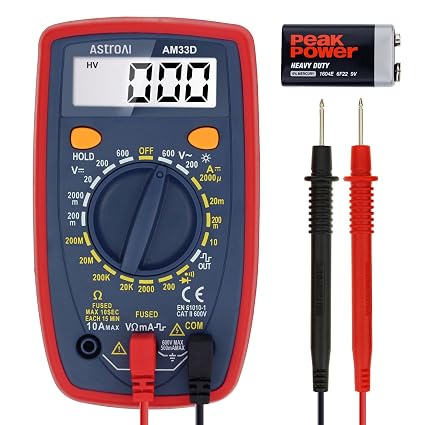
- Estimated Price: $10 - $15
- Example Link: AstroAI AM33D on Amazon
Key Specs & Features:
- Manual Ranging: You have to turn the dial to the specific maximum range you expect (e.g., 20V, 200V, 500V) before measuring.
- Basic Measurements: DC/AC Voltage, DC Current (does not measure AC current), Resistance, Continuity Beep, Diode test.
Why these features matter:
- Manual Ranging (The Catch): If you are measuring a 9V battery and set the dial to the “2000mV” (2V) range by mistake, the screen just reads “1” (out of bounds). You have to keep clicking the dial up until you find the right bracket. It forces you to think about what you’re measuring, which is okay for learning, but gets annoying fast.
- No AC Current: It can measure DC current (like from a battery or USB), but if you ever need to measure how much AC current a household appliance is pulling, this meter can’t do it.
- Safety Warning: The internal fuses are basic glass tubes. If you accidentally plug the probes into a wall outlet while the dial is set to “Amps”, a glass fuse can literally shatter.
Verdict: Perfect if you’re on a shoestring budget, checking AA batteries, or doing basic 5V Arduino tutorials. But keep it far away from wall outlets.
2. The Mid-Tier Sweet Spot: Klein Tools MM400 (The Maker’s Best Friend)
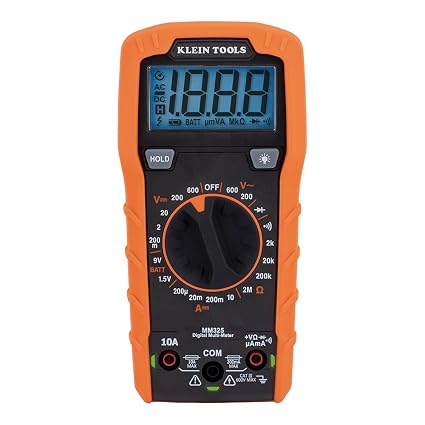
- Estimated Price: $45 - $55
- Example Link: Klein Tools MM400 on Amazon
Key Specs & Features:
- Auto-Ranging: Just turn the dial to “Voltage” and the meter automatically finds the correct range (mV up to 600V) without you guessing.
- Capacitance Testing: Allows you to measure the exact value (Farads) of a capacitor.
- Temperature Probe: Comes with a thermocouple wire to measure physical heat.
- Safety Rating: CAT III 600V, meaning it is legally rated and internally shielded to safely measure standard building wiring.
Why these features matter:
- Auto-Ranging: Saves a massive amount of time when troubleshooting a circuit board with multiple different voltage levels.
- Capacitance: Cheap meters can’t test capacitors. When you are fixing an old TV, monitor, or arcade cabinet, the problem is almost always a blown capacitor. Being able to test them is a game-changer for repair projects.
- Temperature: Extremely useful for 3D printing (checking hotend temps) or finding overheating chips on a broken circuit board.
Verdict: The absolute sweet spot for 90% of DIYers, Makers, and Arduino fans. Safe, reliable, feature-packed, and built by a reputable tool brand.
3. The Pro-Tier Standard: Fluke 115 (The Buy-It-For-Life Tank)
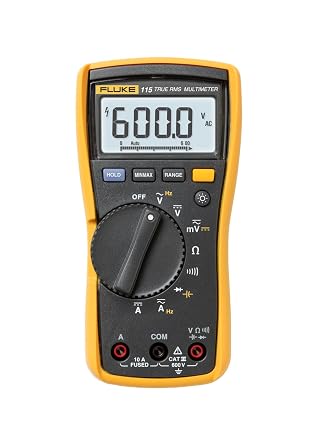
- Estimated Price: $210 - $240
- Example Link: Fluke 115 True-RMS Multimeter
Key Specs & Features:
- True-RMS (Root Mean Square): Accurately measures “noisy” or non-perfect AC electrical waves.
- MIN/MAX/AVG Recording: Automatically records the highest and lowest spikes in voltage over time.
- Ultra-Fast Continuity: The “beep” when touching two connected wires together is instant with zero lag.
- Industrial Build & HRC Fuses: Built to survive a 2-meter drop onto concrete. Uses High Rupture Capacity (HRC) sand-filled fuses that won’t arc or explode under massive power surges.
Why these features matter:
- True-RMS: Cheap meters assume all AC wall power is a perfect, smooth wave. Modern electronics (like LED power supplies, laptop chargers, and motor controllers) create “choppy” AC power. A cheap meter will read this choppy power incorrectly; a True-RMS meter reads it with pinpoint accuracy.
- MIN/MAX Recording: If you have an intermittent power drop causing a Raspberry Pi to reboot randomly, you can leave this meter hooked up. It will trap and save the exact lowest voltage drop that occurred while you weren’t looking.
- Instant Continuity: When you are dragging a probe across 40 tiny pins on a microchip looking for a short circuit, you need the beep to be instant. Cheap meters have a delay, meaning you’ve already moved past the pin before it beeps.
Verdict: Overkill for lighting up LEDs on a breadboard. But for professional electricians, robotics engineers, or anyone working with high voltage, you are paying for extreme accuracy, lightning-fast response times, and absolute safety. A Fluke is a tool you pass down to your kids.