Digital Calipers Showdown: Mitutoyo vs. iGaging vs. Neiko
We’ve all been there: you spend four hours in Fusion 360 designing a beautiful custom enclosure for your ESP32 project. You send it to the 3D printer, wait another six hours, and excitedly try to snap the board in place… only to realize you were off by 1.5 millimeters because you tried to measure the mounting holes with a chewed-up plastic elementary school ruler. Now you have a very expensive piece of plastic spaghetti and a burning hatred for the imperial system.
Enter the digital caliper. It’s the difference between “precision engineering” and “eyeballing it with a sharpie.” Whether you’re measuring the leg spacing on LEDs or verifying a component footprint before designing your first PCB, a caliper is your best friend. But do you really need to spend over $120 for the gold standard, or will a $20 Amazon freebie do the job before its battery dies mid-measurement?
We’re comparing the legendary Mitutoyo, the mid-range iGaging, and the budget Neiko to see how much precision you actually need.
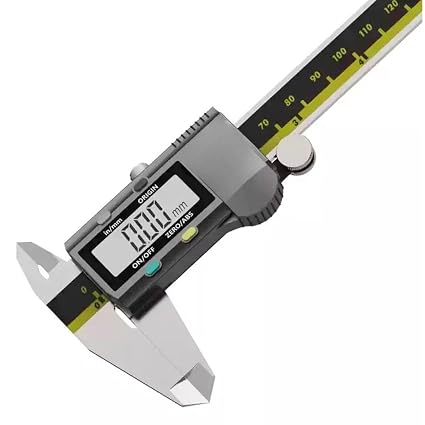
1. The Gold Standard: Mitutoyo 500-196-30 AOS Absolute Scale
Best for: Professionals, Machinists, and Serious Makers
If you ask any professional engineer or machinist what caliper to buy, 99% of them will say “Mitutoyo.” This Japanese-made tool is the benchmark against which all others are measured.
Key Features
- AOS (Advanced Onsite Sensor): The electromagnetic inductive sensor makes it highly resistant to dirt, oil, and water.
- Absolute Scale (ABS): It remembers its position even when turned off. You never have to re-zero it after turning it back on.
- Silky Smooth Action: The thumb roller glides effortlessly without any grinding or sticking.
- Insane Battery Life: A single SR44 battery will last for years (3.5+ years of normal use).
Why it matters for pros vs. beginners:
For a beginner, the high price tag is hard to justify. But for a professional designing precision PCBs where a 0.1mm error means a component won’t fit on the board, the Mitutoyo offers unmatched reliability and peace of mind. It simply works, every single time.
Buy the Mitutoyo 500-196-30 on Amazon
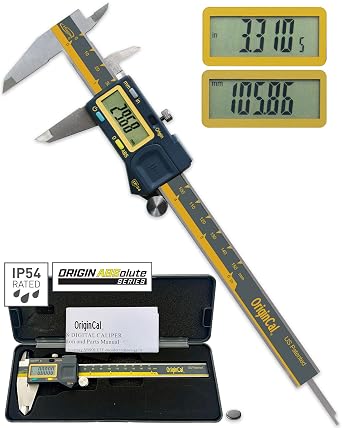
2. The Mid-Tier Contender: iGaging ABSolute Origin 0-6”
Best for: Intermediate Makers and 3D Printing Enthusiasts
The iGaging ABSolute Origin is often hailed as the “poor man’s Mitutoyo.” It attempts to replicate the high-end features at roughly a third of the cost.
Key Features
- Absolute Origin Technology: Like the Mitutoyo, it remembers its zero position, meaning no more accidental re-zeroing mid-measurement.
- IP54 Rating: Resistant to dust and splashes, which is great for messy workbenches.
- High Accuracy: While not certified to the same extreme standards as Mitutoyo, it is incredibly accurate and repeatable for general electronics and 3D printing.
Why it matters for pros vs. beginners:
This is the sweet spot for most hobbyists. It fixes the biggest annoyance of budget calipers (constantly losing zero and chewing through batteries) without breaking the bank. If you are starting to design your own custom enclosures or checking resistor tolerances, this is the caliper to get.
Buy the iGaging ABSolute Origin on Amazon
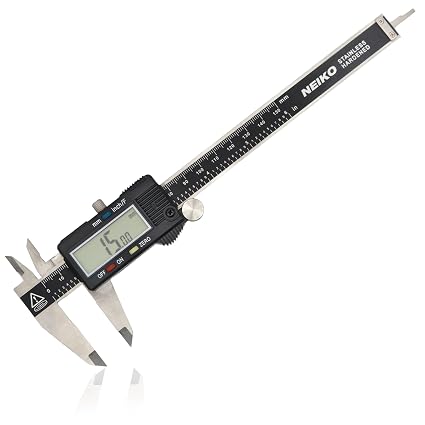
3. The Budget Brawler: Neiko 01407A Electronic Digital Caliper
Best for: Beginners and Occasional DIYers
The Neiko 01407A is one of the most popular budget calipers available. For under $25, you get a solid, stainless steel tool that is vastly superior to the cheap carbon fiber or plastic alternatives floating around the internet.
Key Features
- Stainless Steel Construction: Feels hefty and durable, unlike plastic alternatives.
- Large LCD Screen: Very easy to read, especially if you have less-than-perfect eyesight.
- Fractional Conversion: It can display measurements in inches (decimal), inches (fractions), and millimeters.
Why it matters for pros vs. beginners:
Beginners don’t need sub-mil accuracy. If you’re just measuring the diameter of a screw hole or the thickness of an acrylic sheet for an Arduino starter kit project, the Neiko is more than sufficient. The trade-offs are that the sliding mechanism isn’t as smooth, and it uses LR44 batteries which drain faster (and it occasionally forgets zero if moved too quickly).
Buy the Neiko 01407A on Amazon
Final Verdict
- If budget is no issue and you want a tool that will last a lifetime: Get the Mitutoyo.
- If you want 90% of the performance for 30% of the price: Get the iGaging. It’s the best value for serious makers.
- If you are just getting started and want to save cash for Arduino parts: The Neiko is a perfectly capable entry-level tool.