Have you ever tried to read a tiny sensor, only to find that your microcontroller ignores it like a teenager ignoring chores? The real world is full of whispers, but our digital brains need someone to scream at them. That’s where operational amplifiers (Op-Amps) step in. In this lesson, we’re going to use Op-Amps to boost weak, pathetic signals into something your Arduino can actually hear.
Two Flavors of Amplification
When using an Op-Amp to amplify a signal, we typically configure it in one of two main ways, depending on what we need the output to look like.
1. The Non-Inverting Amplifier
This is the most straightforward setup. The signal goes into the positive input, and the output is an amplified, exact copy of the input—right side up.
- High Input Impedance: It doesn’t draw much current from your delicate sensor, keeping the original signal intact.
- No Phase Shift: If the input voltage goes up, the output voltage goes up.
- Gain is always >= 1: You can’t attenuate (reduce) a signal with this basic setup, only boost it or pass it through unchanged.
2. The Inverting Amplifier
Here, the signal goes into the negative input. The output is amplified, but it’s flipped upside down (inverted) relative to the input.
- Virtual Ground: The positive input is usually tied to ground, creating a “virtual ground” at the negative input.
- Phase Shift: A positive input voltage results in a negative output voltage (and vice versa).
- Gain can be < 1: You can actually use this setup to reduce a signal if needed, as well as boost it.
Key Takeaways for Your Next Project
- Choose the right setup: Need the signal right-side up? Go non-inverting. Building an audio mixer or need specific gain control? Inverting might be better suited for the job.
- Watch your rails: Your amplified signal can’t magically go higher than the power supply you give the Op-Amp (and usually, it clips a bit below that limit).
- Feedback is your friend: Both setups use resistors to feed part of the output back to the input. The ratio of these resistors entirely determines your “gain” (how much the signal is boosted).
With an Op-Amp in your toolkit, no signal is too small to be heard. Grab your breadboard and start amplifying!
Hardware You’ll Need
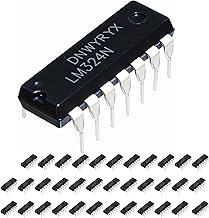
To follow along with this lesson, you’ll need the following components: