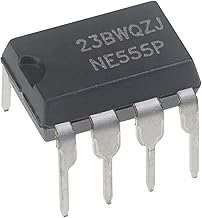
Today, we’re diving into the absolute legend of electronics: the 555 Timer IC. Billions of these little black beetles have been manufactured. It’s the Swiss Army knife of electronics, allowing you to create delays and oscillators without writing a single line of terrible C++ code. If you hate programming but love blinking lights, the 555 Timer is your new best friend.
Astable Mode: The Heartbeat of Your Circuit
The 555 Timer can operate in three main modes (Astable, Monostable, and Bistable), but today we are focusing on Astable mode.
In Astable mode, the 555 Timer acts as an oscillator. It doesn’t have a stable state. Instead, its output continuously toggles between high and low, creating a continuous stream of rectangular pulses (a square wave). Think of it as a metronome or a heartbeat for your electronic circuits.
By carefully selecting the values of just two resistors and one capacitor, you can precisely control:
- Frequency: How fast the output toggles between high and low (the pitch of a tone, or the speed of a blinking LED).
- Duty Cycle: The percentage of time the output stays “high” compared to “low” during one full cycle.
This simple, robust mechanism is why the 555 timer is still the go-to choice for generating pulses, tones, and timing signals in countless projects today. Grab your breadboards, and let’s get wiring!
Hardware You’ll Need
To follow along with this lesson, you’ll need the following components: