Up until now, we’ve looked at resistors and capacitors as individuals. Resistors resist, capacitors hoard charge. But what happens when you force them to work together? Magic happens. Or, more accurately, frustrating analog math happens. When you combine a resistor and a capacitor, you create an RC circuit. These are the foundation of analog timing and filtering, and they are here to remind you why you hated calculus.
The RC Time Constant (τ)
The most important concept in an RC circuit is the time constant, usually represented by the Greek letter tau (τ).
When you apply voltage to an RC circuit, the capacitor doesn’t charge instantly. The resistor slows down the flow of current, acting like a bottleneck. The time it takes for the capacitor to charge up depends on the size of the resistor and the size of the capacitor.
The formula for the time constant is beautifully simple:
τ = R × C
- τ (Tau) is the time in seconds.
- R is the resistance in ohms (Ω).
- C is the capacitance in farads (F).
One time constant (τ) is the time it takes for the capacitor to charge to approximately 63.2% of the supply voltage.
It takes about 5 time constants (5τ) for the capacitor to be considered fully charged (to about 99.3% of the supply voltage). The same applies when discharging: one time constant gets you down to 36.8%, and five time constants means it’s fully discharged.
Visualizing the Charge
Imagine a water tank (capacitor) being filled through a narrow pipe (resistor).
- If the tank is huge (large C) and the pipe is narrow (large R), it takes a long time to fill.
- If the tank is small (small C) and the pipe is wide (small R), it fills up almost instantly.
Why Do We Care?
RC circuits are everywhere in electronics. Here are a few common ways they are used:
- Timing: Before microcontrollers were everywhere, RC circuits were the primary way to create delays. If you need an LED to stay on for exactly two seconds after a button press, you calculate the R and C values to give you that specific delay. The classic 555 timer IC relies heavily on external RC circuits to set its timing.
- Filtering (Low-Pass Filter): If you connect an RC circuit in a specific way (signal goes through the resistor, capacitor connects to ground), it acts as a low-pass filter. It allows low-frequency signals to pass through but blocks high-frequency noise. This is crucial in audio circuits and power supplies.
- Debouncing: Mechanical switches are bouncy. When you press a button, the metal contacts literally bounce against each other for a few milliseconds, creating a noisy signal. An RC circuit can smooth out that noise so your microcontroller only registers a single clean button press.
- Signal Smoothing: In power supplies, after AC is converted to DC, the signal is often “bumpy.” A large capacitor in an RC arrangement helps smooth out those bumps, providing a clean, steady DC voltage.
Next time you see a resistor and a capacitor sitting next to each other on a circuit board, you’ll know they are likely working together as an RC circuit, shaping time and smoothing signals!
Hardware You’ll Need
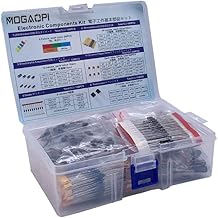
To follow along with this lesson, you’ll need the following components: