Ever write an Arduino sketch filled with delay() functions, only to realize your buttons are completely ignoring you? Your Arduino is too busy doing nothing during that delay to notice your frantic button pressing.
Stop polling like a chump. Enter the magic of hardware interrupts. It’s the microcontroller equivalent of tapping someone on the shoulder and screaming “PAY ATTENTION TO ME NOW.”
What is a Hardware Interrupt?
Think of a hardware interrupt as a tap on the shoulder for your microcontroller. No matter what your Arduino is currently doing (even if it’s stuck in a long delay or a heavy calculation), an interrupt forces it to drop everything, handle the event immediately, and then resume exactly where it left off.
Here are a few reasons why interrupts are game-changers:
- Instant Response: Your system reacts to real-world events the exact millisecond they happen.
- No More Polling: You don’t need to constantly check
digitalRead()in yourloop()to see if a button state changed. - Cleaner Code: It allows your main
loop()to focus on the big picture instead of micro-managing inputs. - Power Efficiency: You can put the Arduino to sleep and use an interrupt to wake it up!
How to Use attachInterrupt()
To use a hardware interrupt on an Arduino Uno, you typically use pins 2 or 3. Here is a simple example that turns on an LED when a button is pressed, using an interrupt.
const byte ledPin = 13;
const byte interruptPin = 2;
volatile byte state = LOW;

void setup() {
  pinMode(ledPin, OUTPUT);
  pinMode(interruptPin, INPUT_PULLUP);

  // Attach the interrupt to pin 2
  // Trigger the blink() function when the pin goes from HIGH to LOW (FALLING edge)
  attachInterrupt(digitalPinToInterrupt(interruptPin), blink, FALLING);
}

void loop() {
  // The main loop can do whatever it wants!
  // The LED state is handled entirely in the background.
  digitalWrite(ledPin, state);

  // Let's pretend we are doing some heavy processing here
  delay(1000);
}

// This is the Interrupt Service Routine (ISR)
void blink() {
  state = !state; // Toggle the state
}
Breaking Down the Code
volatilekeyword: Notice how thestatevariable is declared asvolatile byte. This tells the compiler that this variable can change at any time (outside the normal flow of the program), so it shouldn’t try to optimize it away. Always usevolatilefor variables modified inside an ISR!digitalPinToInterrupt(pin): You should always use this function rather than just typing the interrupt number directly. It ensures your code is portable across different Arduino boards.- The ISR (
blink()): This is the Interrupt Service Routine. It’s the function that gets called when the interrupt triggers. ISRs should be as short and fast as possible. Don’t usedelay()orSerial.print()inside an ISR! FALLING: This is the trigger mode. Because we usedINPUT_PULLUP, the pin is normallyHIGH. Pressing the button connects it to ground, making it goLOW. The transition fromHIGHtoLOWis a “falling” edge.
Interrupts are an essential tool for building responsive, professional-grade projects. Start incorporating them into your builds and see the difference!
Hardware You’ll Need
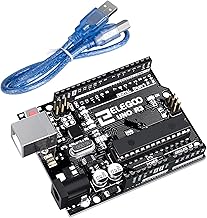
To follow along with this lesson, you’ll need the following components: