Welcome to Lesson 106! Today we are meeting the MVP of modern electronics: the transistor. Without these tiny, three-legged wonders, you wouldn’t have your smartphone, your computer, or the Arduino you’re playing with right now.
Think of a transistor like a water faucet. But instead of using your hand to turn the handle and let water flow, you use a tiny bit of electricity to turn the handle and let a huge amount of electricity flow.
How Transistors Work
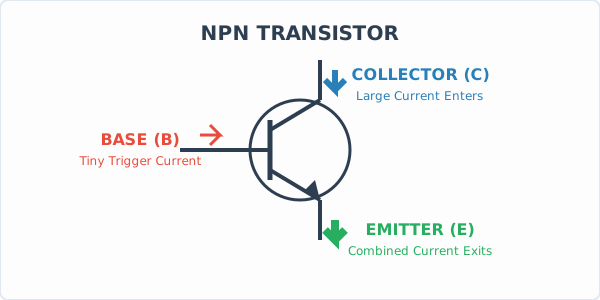
A standard Bipolar Junction Transistor (BJT) has three legs:
- Base: This is the “handle” of the faucet.
- Collector: This is where the high-pressure water (or main power) comes in.
- Emitter: This is where the water flows out.
If you send a tiny trickle of current into the Base, the transistor opens up, allowing a massive rush of current to flow from the Collector through to the Emitter.
If you cut the current to the Base, the transistor slams shut, stopping the main flow completely.
The Two Main Jobs of a Transistor
Because of this behavior, transistors have two main superpowers:
- As a Switch: They allow a weak 5V signal from an Arduino pin to turn on a heavy-duty 12V motor or a blindingly bright LED strip. It’s the ultimate remote control for power.
- As an Amplifier: In analog circuits (like stereos), a tiny audio signal entering the Base gets replicated into a massive, loud signal flowing through the Collector to your speakers.
NPN vs. PNP
There are two flavors of BJTs: NPN and PNP.
- NPN (Not Pointing iN): You give the Base a positive voltage to turn it ON. This is the most common type for Arduino switching projects (like the popular 2N2222 or BC547).
- PNP (Pointing iN Proudly): You pull the Base to ground (negative) to turn it ON.
Next time you need to control something big with something small, don’t try to power it directly from your Arduino pin—that’s a quick way to fry your board. Grab a transistor, and let it do the heavy lifting!
Recommended Gear:
- Transistor Assortment Kit (NPN & PNP)
- Assorted Resistor Kit - You always need a resistor on the Base pin!