Welcome to Diodes 101, where we meet the most passive-aggressive member of your circuit family.
A diode is an electronic component that acts as a one-way valve for electricity. It lets current flow easily in one direction, but if you try to go the other way? “NOPE. Not today, Satan.”
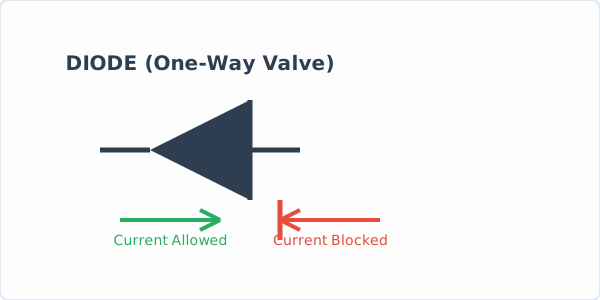
In schematic diagrams, a diode is drawn as an arrow pointing to a line. That’s not symbolism. That’s literally what it does: the arrow shows the allowed direction of current, and the line represents the brick wall blocking backward flow.
Why Do We Need Diodes?
- Polarity Protection: Saving your circuit from you accidentally plugging that power supply backward (We see you). By placing a diode at the power input, you ensure that if the power is reversed, the current is blocked, saving your delicate microchips from releasing the magic smoke.
- Rectification (AC to DC): Alternating Current (AC) constantly changes direction. By using diodes in a specific arrangement (like a Bridge Rectifier), you can force the AC current to flow in only one direction, effectively converting it into Direct Current (DC) like a boss.
- Flyback Protection: When you turn off a motor or a relay, the sudden collapse of the magnetic field can send a massive voltage spike backward through the circuit. A “flyback diode” gives that spike a safe one-way path back into the motor coil, protecting the rest of your components.
Types of Diodes
- Standard Rectifier Diode: The OG gatekeeper used for general power conversion and protection.
- Zener Diode: A rebel specifically designed to allow current to flow backwards on purpose, but only when the voltage reaches a certain specific level. They are excellent for regulating voltage.
- Schottky Diode: Known for switching very fast and having a very low voltage drop. Think of them as your one friend who is always early.
So next time your circuit mysteriously refuses to flow in one direction, check the diode. It’s probably standing there, arms crossed, muttering: “I said what I said.”
Recommended Gear:
- Assorted Diode Kit (Rectifier, Schottky, Zener) - A vital kit for protecting your advanced circuits.
- Breadboard Jumper Wire Kit