Welcome to Lesson 103! Let’s talk about resistors, aka the wet blankets of your circuit’s rave.
What’s their deal? They exist solely to ruin electricity’s good time. Voltage shows up like, “Let’s PARTY!” and the resistor’s like, “Calm down, you’re gonna blow a fuse.”
What is a Resistor’s Job?
A resistor’s primary purpose is to limit electrical current—exactly like a bouncer at Club LED. Too much energy? DENIED. Too little? Come on in.
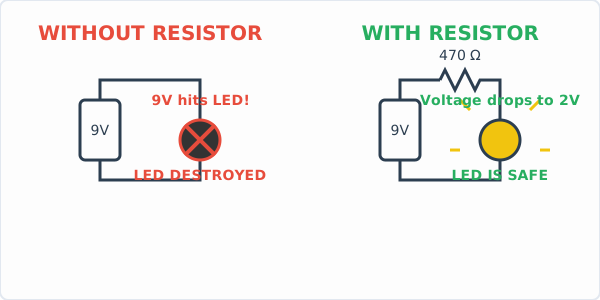
Without resistors, many sensitive electronic parts would receive too much power and instantly burn out.
Common Uses for Resistors
- Protecting LEDs: An LED requires very little current to light up. If you connect an LED directly to a 5V source, it will become a tiny flashbang and die instantly. A resistor limits the current to a safe level, allowing the LED to survive.
- Voltage Dividers: By using two resistors together, you can split a higher voltage down to a lower, specific voltage needed by a delicate sensor.
- Vibing: Just sitting there on the breadboard, doing absolutely nothing obvious until you remove them and your whole project catches fire.
How to Read a Resistor
Most standard through-hole resistors have colored bands painted on them. Those color bands aren’t decoration—they’re a secret mathematical code.
For example, a resistor with Brown, Black, and Red bands has a value of 1,000 Ohms (or 1kΩ). (Pink, glitter, and unicorn? Okay, that’s a Lisa Frank sticker. Wrong component, champ).
Resistors don’t care about your feelings or the circuit’s dreams. Their motto is simply: “Nobody moves fast on my watch.” So next time your LED survives, thank the resistor. It died for your lack of a current-limiting calculation.
Recommended Gear:
- Resistor Color Code Chart / Cheat Sheet
- Assorted Resistor Kit (10 Ohms to 1M Ohms) - You will need hundreds of these as you build more projects!