Welcome to Lesson 102! Today, let’s talk about capacitors—those tiny soda cans scattered across your circuit board that refuse to act normal.
What Does a Capacitor Do?
Their primary job is simple but crucial: they store electrical energy and release it when needed. Think of a capacitor like a tiny energy hoarder. It stores energy exactly like your grandma stores Tupperware lids: obsessively and with zero explanation.
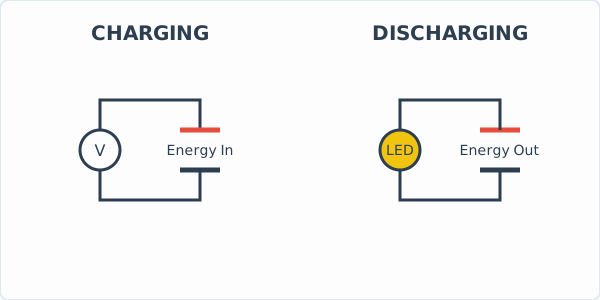
- Charging: When you apply voltage to a capacitor, it’s like “OMG, yes please!” and quickly charges up.
- Holding: Once full, it just sits there… judging your circuit.
- Discharging: When the circuit needs power, or if the main power source drops, they dump their energy like they’re rage-quitting a relationship. BAM. Instant power burst.
How They Are Used
Capacitors behave differently depending on the type of power running through the circuit:
- In DC (Direct Current) circuits: They charge up to match the voltage, chill out, and block any further continuous flow of current.
- In AC (Alternating Current) circuits: Because the voltage is constantly changing directions, the capacitor goes on a rollercoaster of emotions (charge–discharge–repeat).
- Real-world applications: They are used in camera flashes for sudden energy bursts, in power supplies to “smooth out” fluctuating voltage like a digital therapist, and in audio equipment to filter out unwanted frequencies.
Safety Warning: Polarity Matters
Some capacitors, like the little flat ceramic ones, can be plugged in either way. However, electrolytic capacitors (the ones that look like tiny soda cans) are directional. They have a positive and a negative leg.
If you connect an electrolytic capacitor backward, it might explode with a tiny dramatic puff of smoke. It’s like saying “no” to pineapple on pizza—it just causes chaos. Always check the stripe on the side for the negative leg!
Recommended Gear:
- Capacitor Assortment Kit - A must-have for repairing and building power circuits.
- Breadboard Power Supply Module - Great for safely testing capacitors on your breadboard.